


INCOMPLETE KNOWLEDGE HAS CONSEQUENCES
Detecting pathogenic gene fusions in cancer is critical to help improve outcomes for patients1-3
Understanding the drivers of cancer
Pathogenic gene fusions typically occur when 2 different genes join to form an abnormal hybrid gene and are among the most common genomic alterations driving cancer growth. Recognizing the clinical impact of pathogenic gene fusions can provide insight into clinical decision making.1,4,5
EXPLORE PATHOGENIC GENE FUSIONSNRG1: A dangerous fusion emerges
Among the gene fusions that drive cancer, NRG1 is an emerging threat. NRG1 fusions have been identified across multiple tumor types and are associated with aggressive features and poor clinical outcomes.6-9
DISCOVER NRG1 FUSIONSRevealing what may be missed
RNA-based NGS testing, including DNA and RNA sequencing, of tumor tissue helps identify genomic alterations, including pathogenic gene fusions such as NRG1, which may often be missed with other methods. This comprehensive approach optimizes the identification of oncogenic drivers to help inform treatment decisions.6,10-12
LEARN ABOUT RNA-BASED NGSWatch Dr Iams discuss RNA-based NGS testing of tumor tissue
LEARN ABOUT RNA-BASED NGSExplore professional materials
Deepen your understanding with professional resources that highlight essential concepts in oncology, such as pathogenic gene fusions and the science behind fusion detection.
ACCESS ALL RESOURCES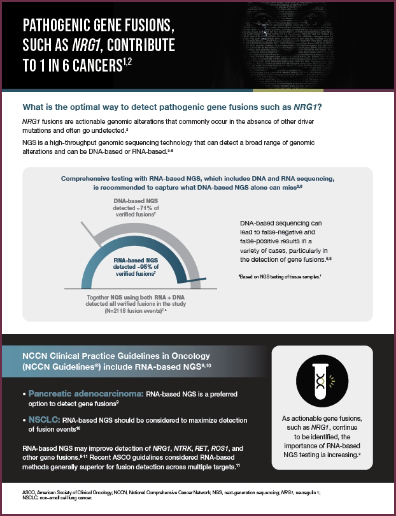
Comprehensive
NGS Testing
NGS Testing
Gain insights into NGS testing platforms and commercial labs that offer RNA-based NGS testing, including DNA and RNA sequencing.
DOWNLOAD NOWNGS, next-generation sequencing; NRG1, neuregulin 1.
References: 1. Gao Q, Liang W-W, Foltz SM, et al. Driver fusions and their implications in the development and treatment of human cancers. Cell Rep. 2018;23(1):227-238.e3. doi:10.1016/ j.celrep.2018.03.050 2. Chang JC, Offin M, Falcon C, et al. Comprehensive molecular and clinicopathologic analysis of 200 pulmonary invasive mucinous adenocarcinomas identifies distinct characteristics of molecular subtypes. Clin Cancer Res. 2021;27(14):4066-4076. doi:10.1158/1078-0432.CCR-21-0423 3. Cobain EF, Wu Y-M, Vats P, et al. Assessment of clinical benefit of integrative genomic profiling in advanced solid tumors. JAMA Oncol. 2021;7(4):525-533. doi:10.1001/jamaoncol.2020.7987 4. Latysheva NS, Babu MM. Discovering and understanding oncogenic gene fusions through data intensive computational approaches. Nucleic Acids Res. 2016;44(10):4487-4503. doi:10.1093/nar/gkw282 5. Nikanjam M, Okamura R, Barkauskas DA, Kurzrock R. Targeting fusions for improved outcomes in oncology treatment. Cancer. 2020;126(6):1315-1321. doi:10.1002/cncr.32649 6. Drilon A, Duruisseaux M, Han J-Y, et al. Clinicopathologic features and response to therapy of NRG1 fusion–driven lung cancers: the eNRGy1 Global Multicenter Registry. J Clin Oncol. 2021;39(25):2791-2802. doi:10.1200/JCO.20.03307 7. Jonna S, Feldman RA, Swensen J, et al. Detection of NRG1 gene fusions in solid tumors. Clin Cancer Res. 2019;25(16):4966-4972. doi:10.1158/1078-0432.CCR-19-0160 8. Rosas D, Raez LE, Russo A, Rolfo C. Neuregulin 1 gene (NRG1). A potentially new targetable alteration for the treatment of lung cancer. Cancers (Basel). 2021;13(20):5038. doi:10.3390/cancers13205038 9. Dhanasekaran SM, Balbin OA, Chen G, et al. Transcriptome meta-analysis of lung cancer reveals recurrent aberrations in NRG1 and Hippo pathway genes. Nat Commun. 2014;5:5893. doi:10.1038/ncomms6893 10. Benayed R, Offin M, Mullaney K, et al. High yield of RNA sequencing for targetable kinase fusions in lung adenocarcinomas with no mitogenic driver alteration detected by DNA sequencing and low tumor mutation burden. Clin Cancer Res. 2019;25(15):4712-4722. doi:10.1158/1078-0432.CCR-19-0225 11. Owen D, Ben-Shachar R, Feliciano J, et al. Actionable structural variant detection via RNA-NGS and DNA-NGS in patients with advanced non-small cell lung cancer. JAMA Netw Open. 2024;7(11):e2442970. doi:10.1001/jamanetworkopen.2024.42970 12. Iams WT, Mackay M, Ben-Shachar R, et al. Concurrent tissue and circulating tumor DNA molecular profiling to detect guideline-based targeted mutations in a multicenter cohort. JAMA Netw Open. 2024;7(1):e2351700. doi:10.1001/jamanetworkopen.2023.51700